
Washer Shaking, Banging or Walking? Causes and Fixes
New washer? Check the shipping bolts
Front-load washers are shipped with bolts that lock the drum in place so it is not damaged in transit. These are usually on the back panel, and they must be removed before the first use. If they are left in, the drum cannot move on its suspension and the whole machine shakes hard and can walk during the first spin.
If your washer is new or was recently moved, look for these bolts. Your owner's manual shows where they are and usually includes plastic caps to cover the holes once they are out. Keep the bolts in case you move again.
Level the washer properly
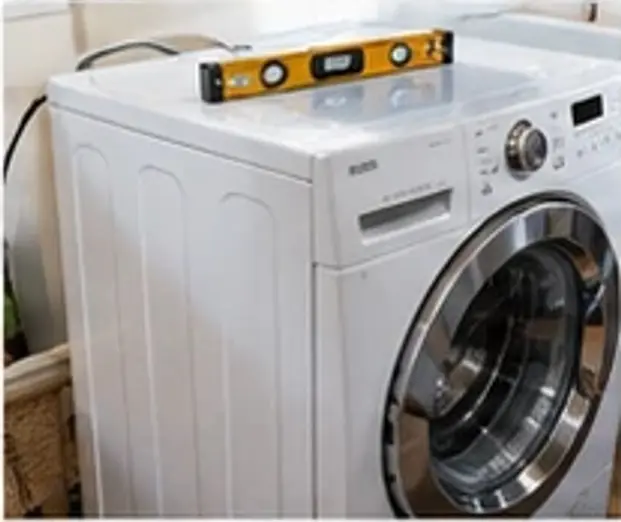
Even a slight tilt makes a spinning drum wobble. Unplug the washer and place a level across the top, front to back and side to side.
- Adjust the front feet by turning them in or out, then tighten the lock nuts against the cabinet so they do not creep.
- On many top-loaders, the rear legs are self-leveling. Tilt the machine forward a few inches and set it back down to let them adjust.
- Push on opposite corners. If the washer rocks, one foot is not touching the floor.
- Make sure the washer is not touching the wall, the dryer or a cabinet, which can amplify vibration into banging.
Load the drum the right way
Most shaking during spin comes from how the clothes are distributed rather than from a broken part.
- Single heavy items. A bath mat, comforter or pair of jeans alone forms one heavy lump. Add a few towels to balance it.
- Mixed fabrics. Heavy towels mixed with light synthetics can bunch up on one side.
- Overloading. A packed drum cannot redistribute clothes before spinning.
- Top-loaders with an agitator. Arrange clothes loosely around the agitator rather than wrapping them around it.
Many modern washers detect imbalance and try to redistribute the load. If they cannot, they slow the spin or stop with a code. On many LG and Samsung washers this appears as UE or a similar unbalanced code, and the Samsung washer codes page explains the rest.
Floors, platforms and stacked units
Washers on wooden subfloors, especially in older homes and upstairs laundry rooms, can shake more because the floor itself flexes. A sturdy, level surface makes a big difference. Rubber anti-vibration pads under the feet help on hard floors, though they do not fix an unlevel machine. In some homes, adding a piece of thick plywood under the washer spreads the load across more floor joists and reduces bounce.
Pedestals should be fully assembled and level, and the washer should be secured to them as the manufacturer describes. For stacked washer-dryer sets, confirm the stacking kit is installed and tight. A loose stack can shift during spin, which is a safety issue as well as a noise problem. If you need help setting a washer or stack up correctly, we also offer appliance installation.
Worn parts that cause shaking
If a level, balanced washer still bangs or thumps, the parts that hold the tub steady are likely worn.
- Suspension rods or springs (top-loaders). Many top-loaders hang the tub on rods or springs. When they wear, the tub swings and strikes the cabinet during spin.
- Shock absorbers or dampers (front-loaders). These control drum movement. Worn ones let the drum bounce, often with a loud thump at the start of spin.
- Drum bearings. A rumbling or roaring sound that grows with spin speed, often with a wobbling drum, points to bearings. This is a larger repair.
- Snubber or tub support. Some top-loaders use a friction pad that wears down over time and causes shaking and squeaks.
A quick test: with the washer off and empty, push the tub or drum down and let go. It should settle rather than keep bouncing. On a top-loader, also look at the gap between the tub and the cabinet. A tub that sits visibly off center when empty usually has a worn or broken suspension rod on one side.
When to call a technician
Book service if the washer still shakes after leveling and balancing, if the drum keeps bouncing when pressed, if you hear rumbling or grinding during spin, or if the tub hits the cabinet. Running a washer that bangs hard can damage the tub, the bearings and the floor around it.
Our technicians replace suspension rods, shocks, dampers and bearings as part of our washer repair service across Metro Atlanta, on brands such as Whirlpool, Maytag, GE and Kenmore. The $80 diagnostic is credited toward the repair if you move ahead. Give us a call at (678) 866-3669 or pick a time online.
Need it fixed?
Our technicians handle washer repair across Metro Atlanta, usually the same day. Diagnostic from $80, credited toward your repair.
Call (678) 866-3669FAQs
Why does my washer shake only during the spin cycle?
Spin is when the drum turns fastest, so any imbalance in the load, unlevel feet or worn suspension parts show up there. Start by leveling the machine and spreading the load evenly before suspecting a part.
How do I stop my washing machine from walking?
Level all four feet and tighten the lock nuts, balance the load, and remove shipping bolts on a new front-loader. Anti-vibration pads can help on smooth floors. If it still moves, the suspension may be worn.
Is it safe to use a washer that shakes a lot?
Occasional mild wobble is normal, but heavy banging can damage the tub, bearings, nearby walls or a stacked dryer. Stop using it until it has been leveled and checked.
More repair guides
Washing Machine Not Draining or Spinning? Causes and Fixes
A washer that will not drain or spin usually has a clogged drain pump filter, a kinked or blocked drain hose, a failed drain pump, or a lid or door lo…
Read the guide →
Washer Leaking Water? How to Find the Leak and Fix It
Washing machine leaks most often come from worn fill hoses, a torn or dirty door gasket on front-loaders, too much detergent, a loose drain pump filte…
Read the guide →
Washer Won't Start? Step-by-Step Checks and Common Causes
When a washer will not start, the cause is often simple: no power at the outlet, a tripped breaker or GFCI, a control lock or delay start that is turn…
Read the guide →