
Thanksgiving Oven Checklist: Test Your Oven Before the Big Meal
Why test the oven before the holiday, not on the day
Most ovens get light use for weeks at a time, then on Thanksgiving they run for six or more hours straight with the door opening constantly. That long, hot stretch is exactly when a tired bake element, a weak gas igniter or a sticky thermostat sensor gives out.
Finding the problem a week or two early turns an emergency into an ordinary appointment. Repair visits get busier as the holiday approaches, and parts for some models need to be ordered, so the earlier you know, the more options you have. A 20-minute test this weekend is the cheapest insurance you can buy for the meal, and it takes nothing more than a thermometer and a tray of cookies.
Step 1: Check the real temperature with an oven thermometer
The number on the display is what the oven is aiming for, not proof that it got there. An inexpensive oven thermometer from a grocery or hardware store tells you the truth.
- Place the thermometer on the middle rack, in the center.
- Set the oven to 350°F and let it run for about 20 minutes after the preheat signal.
- Read the thermometer without opening the door if you can see through the glass. Opening it drops the temperature and skews the reading.
- Check again 10 minutes later. Ovens cycle above and below the set point, so look at the average.
A reading within about 25 degrees is normal for most home ovens. If it is further off, many models let you adjust the calibration from the control panel; your owner's manual explains how. If it is far off, or swings wildly, a temperature sensor or control problem is likely.
Step 2: Watch how it preheats
Time the preheat from a cold start. You do not need a stopwatch, just a sense of whether it is in line with what you are used to. An oven that suddenly takes twice as long, or never signals that it is ready, is telling you something.
- Electric ovens: look through the window. The bake element on the bottom should glow evenly red along its whole length. A dark section, a blister or a visible break means the element is failing.
- Gas ovens: the burner should light within a minute or so of turning the oven on. A glowing igniter with no flame, or a flame that lights only after a long delay, usually points to a weak igniter. Our guide to an oven not heating covers the common causes.
If anything looks off, note it and turn the oven off. Do not run it unattended to see if it improves.
Step 3: Do a real test bake
A thermometer shows the temperature in one spot. A test bake shows how heat moves around the whole cavity, which matters when the oven is packed with a turkey and side dishes.
Bake a sheet of refrigerated biscuits or a batch of cookies spread across the full pan. Even browning from front to back and side to side means the oven is in good shape. Pale cookies on one side and burnt ones on the other often mean a convection fan, element or burner problem. Our page on an oven not heating evenly walks through the usual causes.
While it bakes, check that the oven light works and that the timer and clock respond normally. Small control glitches tend to get worse, not better, during a long day of cooking.
Step 4: Check the cooktop, door and racks
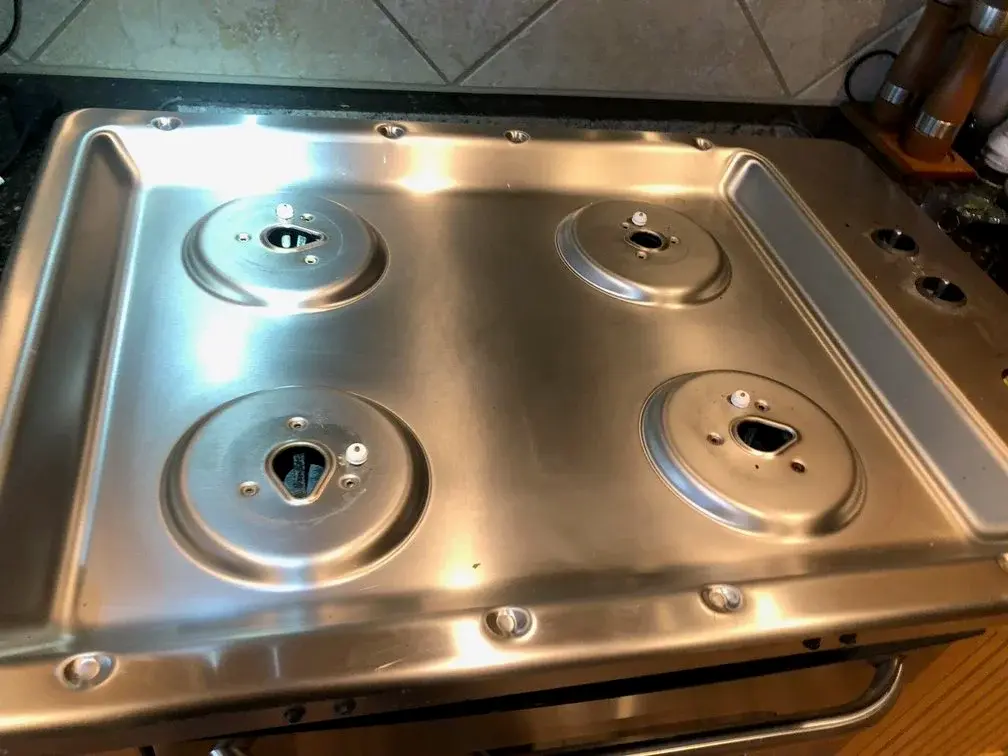
- Every burner. Light each gas burner and look for a steady blue flame all the way around. On an electric or smooth-top range, turn each element to high and confirm it heats. A gas burner that clicks without lighting is covered in our guide to a stove burner that won't light.
- Door gasket. Run your fingers along the seal around the oven opening. Gaps, tears or flattened sections let heat escape and slow cooking.
- Door hinges. The door should close fully on its own and stay shut. A door that sits slightly open loses heat and can make the oven run long.
- Racks and pan fit. Put your roasting pan in with the rack at the height you plan to use. Finding out the turkey will not fit while it is raw and on the counter is a stress you can skip.
Skip the self-clean cycle right before the holiday
It is tempting to run self-clean so the oven looks fresh for guests. The trouble is that the cycle heats the oven far higher than normal cooking, often for several hours, and that extra heat is hard on door locks, control boards, sensors and fuses. On many models, an oven that was already marginal fails during or just after a self-clean.
If you want to clean the oven, either run self-clean well ahead of time, at least a couple of weeks before Thanksgiving, so there is room to fix anything that goes wrong, or wipe it down by hand with a non-abrasive cleaner instead. Remove the racks first if your manual says they should not stay in during self-clean.
Any time you smell gas, whether during a test or on the day, turn the oven off if it is safe to do so, leave the home and call your gas utility from outside.
When to call a technician
Schedule a repair if the thermometer reading is far from the set temperature, the bake element shows damage, a gas oven lights late or not at all, a burner will not ignite after cleaning, or the control panel shows an error. Booking early in November gives you the widest choice of appointment times before the holiday rush.
Mr. Fixer provides oven and cooktop repair throughout Metro Atlanta for brands like GE, Whirlpool, Frigidaire and Samsung. The $80 diagnostic for a range or stove ($120 for built-in and double wall ovens) is credited toward the repair, and you get a written estimate before any work. Call (678) 866-3669 or book online. For typical costs, see our oven repair cost guide.
Need it fixed?
Our technicians handle oven & cooktop repair across Metro Atlanta, usually the same day. Diagnostic from $80, credited toward your repair.
Call (678) 866-3669FAQs
How far ahead of Thanksgiving should I test my oven?
One to two weeks ahead is a good window. It gives you time to schedule a technician and wait for a part if one has to be ordered, without cutting it close to the holiday.
How accurate should my oven temperature be?
Most home ovens are considered normal if the average reading stays within about 25 degrees of the setting. Ovens cycle up and down, so take more than one reading before deciding it is off.
Is it safe to run self-clean before Thanksgiving?
It is safest to run it at least a couple of weeks before the holiday, or to clean by hand. The very high heat of self-clean can push a worn part to fail, and you want time to fix it.
Can I keep using my oven if it runs hot or cold?
You can often cook around a small offset by adjusting the setting, but a large or changing error usually means a failing sensor, element, igniter or control. Have it checked before you rely on it for a big meal.
More repair guides
Oven Not Heating? Causes and Fixes for Gas and Electric
An electric oven that will not heat most often has a burned-out bake element, a tripped breaker, or a failed temperature sensor or control, while a ga…
Read the guide →
Oven Not Heating Evenly? Causes and Fixes for Uneven Baking
Uneven baking is often caused by rack position, pans that block airflow, a short preheat, or a door that is opened often. If those are ruled out, the …
Read the guide →
How Much Does Oven Repair Cost in Atlanta?
Oven repair pricing at Mr. Fixer depends on the type of oven. For a freestanding range oven, the diagnostic is $80 and repairs start from $180 plus pa…
Read the guide →